

KTH Royal Institute of Technology
MSc Systems, Control and Robotics
Stockholm, Sweden
Master degree
DURATION
2 years
LANGUAGES
English
PACE
Full time
APPLICATION DEADLINE
EARLIEST START DATE
Aug 2027
TUITION FEES
SEK 360,000 *

STUDY FORMAT
On-Campus
* for non-EU/EEA/Swiss | no tuition fee for citizens of EU/EEA country or Switzerland
Key Summary
About: The MSc Systems, Control and Robotics at KTH focuses on analysis, design and control of robots, autonomous vehicles and complex systems. It offers specialisations in sensing, AI, machine learning, decision making and control. The two-year programme (120 ECTS credits) is taught in English at KTH's School of Electrical Engineering and Computer Science and includes foundation courses, two tracks, electives, seminars and a project-based degree project.
Career Outcomes: Graduates enter industry or research and can work as a control and automation specialist, robotic navigation and perception specialist, AI and machine learning specialist, robotics engineer, or pursue doctoral studies across many sectors.
The master’s programme in Systems, Control and Robotics focuses on the analysis, design and control of robots, autonomous vehicles, and other complex technical systems. It provides broad skills in the field and expertise through specialisations going deeper into areas such as autonomous sensing, AI, machine learning, decision making and control. Graduates face interesting careers, often in the robotics and autonomous vehicles industry, or as PhD students.
Systems, Control and Robotics at KTH
These systems are essential today and will become even more important as new technology enters our workplaces, homes and shared public spaces.
The programme starts with a few mandatory courses that provide a solid foundation in systems, control and robotics, as well as scientific methodology in general. It continues with courses on one of two tracks chosen by the student. In addition to courses associated with the tracks, there are many elective courses within the broad areas of AI, machine learning and control. To be prepared for a diversity of future careers, you will also take a project course of choice, and participate in a seminar series in which an opportunity is provided to reflect on the societal context of systems, control and robotics, such as sustainability and ethics.
Robotics and autonomous systems
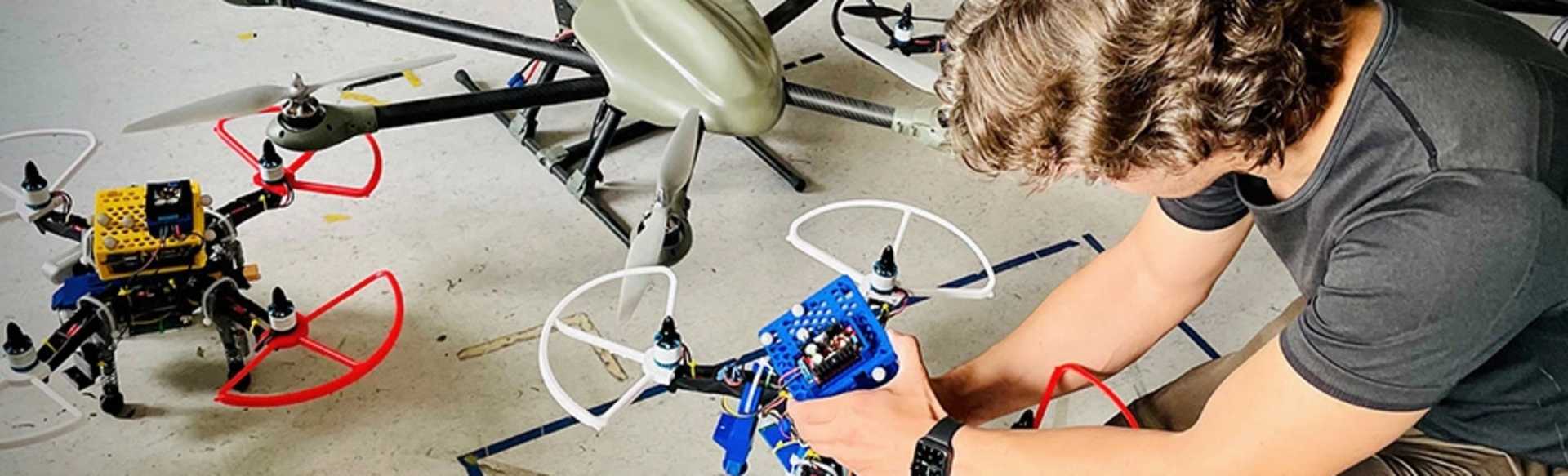
This track focuses on autonomous mobile systems that act in a dynamic world, including robots, drones and autonomous vehicles. Such systems need to act rationally based on information from complex sensors such as cameras or laser scanners, to achieve both short- and long-term objectives in a changing world. As an example, in the project course DD2419, you might be tasked with programming the sensing, actuation and planning modules of a small robot performing a mission in a challenging environment.
Learning, Decision and Control Systems
This track focuses on analysing and synthesising decision and control systems, both model-based, including classical control systems and AI, and data-driven systems with machine learning components. As an example, in the project course EL2425, you might be developing real-time controllers for a set of 1:8 scale autonomous cars.
This is a two-year programme (120 ECTS credits) in English. Graduates are awarded a Master of Science Degree. The programme is given mainly at the KTH Campus in Stockholm by the School of Electrical Engineering and Computer Science (at KTH).
This is a two-year programme (120 ECTS credits) in English. Graduates are awarded a Master of Science Degree. The programme is given mainly at the KTH Campus in Stockholm by the School of Electrical Engineering and Computer Science (at KTH).
Master Degree Project
All students complete a degree project, typically during the second half of the second year, upon completing the necessary programme credits. The project may involve work in a relevant industry or a department at KTH, and may be combined with coursework. For students who wish to pursue a career in research, the degree project offers an excellent opportunity to develop contacts and the skills necessary to work within a research group. For those students wishing to enter industry, it serves as an important introduction and practical foundation for a career with a prospective employer.
The courses in the programme cover topics such as robotics, control theory, artificial intelligence, machine learning and dynamical systems.
Year 1
The following course requirements need to be satisfied to get a degree:
- all common mandatory courses of 30 credits
- all mandatory courses of 15 credits, depending on track
- at least 21 credits of the conditionally elective courses, depending on the track
- at least one project course completed
- degree project equivalent to 30 credits completed
- freely elective courses up to 120 credits
Compulsory and conditionally elective courses from one track are recommended on all other tracks.
A course can only be listed once below and is listed only as compulsory if it is compulsory on one track and only conditionally elective on another.
Mandatory courses for all tracks
- Introduction to Robotics (DD2410) 7.5 credits
- The Sustainable Systems and Control Engineer (EL2220) 3.0 credits
- Control Theory and Practice, Advanced Course (EL2520) 7.5 credits
- Modelling of Dynamical Systems (EL2820) 7.5 credits
Recommended courses for all tracks
- Program System Construction Using C++ (DD1388) 7.5 credits
- Project Course in Robotics and Autonomous Systems (DD2419) 9 credits
- Probabilistic Graphical Models (DD2420) 7.5 credits
- Deep Learning in Data Science (DD2424) 7.5 credits
- Artificial Intelligence and Multi-Agent Systems (DD2438) 15 credits
- Electricity Market Analysis (EG2210) 7.5 credits
- Building Networked Systems Security (EP2520) 7.5 credits
- Speech and Audio Processing (EQ2321) 7.5 credits
- Embedded Software (IL2212) 7.5 credits
- Technical Communication in English (LS2444) 7.5 credits
- Applied Vehicle Dynamics Control (SD2231) 7.5 credits
- Applied Linear Optimisation (SF2812) 7.5 credits
- Geometric Control Theory (SF2842) 7.5 credits
- Probability Theory (SF2940) 7.5 credits
- Time Series Analysis (SF2943) 7.5 credits
- Optimisation (SF1861) 6 credits
- Hybrid and Embedded Control Systems (EL2450) 7.5 credits
- Project Course in Data Science (DD2430) 7.5 credits
- Multimodal Interaction and Interfaces (DT2140) 7.5 credits
- Project in Conversational Systems (DT2151) 7.5 credits
- Business Development and Quality Management (EH2030) 7.5 credits
- Management of Projects (EH2720) 7.5 credits
- Build your own Radar System, Project Course (EK2370) 7.5 credits
- Automatic Control, General Course (EL1010) 6 credits
- Automatic Control, Project Course, Smaller Course (EL2425) 7.5 credits
- Nonlinear Control (EL2620) 7.5 credits
- Model Predictive Control (EL2700) 7.5 credits
- Reinforcement Learning (EL2805) 7.5 credits
- Signal Theory (EQ1220) 7.5 credits
- Digital Communications (EQ2310) 9 credits
- Embedded Systems (IL2206) 7.5 credits
- Essential STEM communication in English (LS1452) 7.5 credits
- Rhetoric - the Art of Persuasion (LS1464) 7.5 credits
- English for Employment (LS2442) 7.5 credits
- Industrial Management, Basic Course (ME1003) 6 credits
- Dynamics and Motion Control (MF2007) 9 credits
- Mechatronics Basic Course (MF2030) 6 credits
- Robust Mechatronics (MF2043) 6 credits
- Optimisation (SF1811) 6 credits
- Mathematical Systems Theory (SF2832) 7.5 credits
- Complex Analysis (SF1691) 7.5 credits
- Project in Cognitive Systems (DT2150) 7.5 credits
Learning, Decision and Control Systems track
Compulsory and conditionally elective courses from one track are recommended on all other tracks.
A course can only be listed once below and is listed only as compulsory if it is compulsory on one track and only conditionally elective on another.
Choose at least 21 credits from the list of conditionally elective courses.
Mandatory courses
- Hybrid and Embedded Control Systems (EL2450) 7.5 credits
Conditionally elective courses
- Machine Learning (DD2421) 7.5 credits
- Deep Learning in Data Science (DD2424) 7.5 credits
- Artificial Neural Networks and Deep Architectures (DD2437) 7.5 credits
- Machine Learning Theory (EL2810) 7.5 credits
- Adaptive Signal Processing (EQ2401) 7.5 credits
- Complex Analysis (SF1691) 7.5 credits
- Applied Nonlinear Optimisation (SF2822) 7.5 credits
- Geometric Control Theory (SF2842) 7.5 credits
- Artificial Intelligence (DD2380) 6 credits
- Safe Robot Planning and Control (DD2416) 7.5 credits
- Machine Learning, Advanced Course (DD2434) 7.5 credits
- Robot Learning and Embodied AI (DD2600) 7.5 credits
- Automatic Control, Project Course, Smaller Course (EL2425) 7.5 credits
- Nonlinear Control (EL2620) 7.5 credits
- Reinforcement Learning (EL2805) 7.5 credits
- Cyber-Physical Security in Time-Critical Systems (EL2850) 7.5 credits
- Digital Signal Processing (EQ2300) 7.5 credits
- Mathematical Systems Theory (SF2832) 7.5 credits
Robotics and Autonomous Systems track
Compulsory and conditionally elective courses from one track are recommended on all other tracks.
A course can only be listed once below and is listed only as compulsory if it is compulsory on one track and only conditionally elective on another.
Choose at least 21 credits from the list of conditionally elective courses.
Mandatory courses
- Image Analysis and Computer Vision (DD2423) 7.5 credits
- Applied Estimation (EL2320) 7.5 credits
Conditionally elective courses
- Deep Learning, advanced course (DD2610) 7.5 credits
- Speech and Audio Processing (EQ2321) 7.5 credits
- Research project in Robotics, Perception and Learning (DD2411) 15 credits
- Engineering project in Robotics, Perception and Learning (DD2414) 15 credits
- Project Course in Robotics and Autonomous Systems (DD2419) 9 credits
- Machine Learning (DD2421) 7.5 credits
- Deep Learning in Data Science (DD2424) 7.5 credits
- Artificial Neural Networks and Deep Architectures (DD2437) 7.5 credits
- Artificial Intelligence and Multi-Agent Systems (DD2438) 15 credits
- Speech and Speaker Recognition (DT2119) 7.5 credits
- Machine Learning Theory (EL2810) 7.5 credits
- Dynamics and Motion Control (MF2007) 9 credits
- Hybrid and Embedded Control Systems (EL2450) 7.5 credits
- Artificial Intelligence (DD2380) 6 credits
- Social Robotics (DD2413) 7.5 credits
- Safe Robot Planning and Control (DD2416) 7.5 credits
- Machine Learning, Advanced Course (DD2434) 7.5 credits
- Robot Learning and Embodied AI (DD2600) 7.5 credits
- Automatic Control, Project Course, Smaller Course (EL2425) 7.5 credits
- Nonlinear Control (EL2620) 7.5 credits
- Model Predictive Control (EL2700) 7.5 credits
- Reinforcement Learning (EL2805) 7.5 credits
- Cyber-Physical Security in Time-Critical Systems (EL2850) 7.5 credits
- Digital Signal Processing (EQ2300) 7.5 credits
Year 2
The following course requirements need to be satisfied to get a degree:
- all common mandatory courses of 30 credits
- all mandatory courses of 15 credits, depending on track
- at least 21 credits of the conditionally elective courses, depending on the track
- at least one project course completed
- degree project equivalent to 30 credits completed
- freely elective courses up to 120 credits
Compulsory and conditionally elective courses from one track are recommended on all other tracks.
A course can only be listed once below and is listed only as compulsory if it is compulsory on one track and only conditionally elective on another. Please use the course list for each separate track for a complete account of the conditionally elective courses.
Mandatory courses for all tracks
- The Sustainable Systems and Control Engineer (EL2220) 3 credits
- Degree Project in Computer Science and Engineering, specialising in Systems, Control and Robotics, Second Cycle (DA236X) 30 credits
- Degree Project in Electrical Engineering, specialising in Systems, Control and Robotics, Second Cycle (EA236X) 30 credits
- Theory and Methodology of Science (Natural and Technological Science) (AK2030) 4.5 credits
Recommended courses for all tracks
- Algorithms and Complexity (DD2352) 7.5 credits
- Neuroscience (DD2401) 7.5 credits
- Project Course in Robotics and Autonomous Systems (DD2419) 9 credits
- Probabilistic Graphical Models (DD2420) 7.5 credits
- Mathematical Modelling of Biological Systems (DD2435) 9 credits
- Artificial Intelligence and Multi-Agent Systems (DD2438) 15 credits
- Statistical Methods in Applied Computer Science (DD2447) 6 credits
- Software Reliability (DD2459) 7.5 credits
- Bigger Advanced, Individual Course in Computer Science (DD2464) 9 credits
- Multimodal Interaction and Interfaces (DT2140) 7.5 credits
- Computer Applications and Machine Learning in Electric Power Systems (EG2140) 7.5 credits
- Business Development and Quality Management (EH2030) 7.5 credits
- Management of Projects (EH2720) 7.5 credits
- Build your own Radar System, Project Course (EK2370) 7.5 credits
- Automatic Control, Project Course, Smaller Course (EL2425) 7.5 credits
- Hybrid and Embedded Control Systems (EL2450) 7.5 credits
- Nonlinear Control (EL2620) 7.5 credits
- Model Predictive Control (EL2700) 7.5 credits
- Reinforcement Learning (EL2805) 7.5 credits
- Building Networked Systems Security (EP2520) 7.5 credits
- Digital Communications (EQ2310) 9 credits
- Speech and Audio Processing (EQ2321) 7.5 credits
- Adaptive Signal Processing (EQ2401) 7.5 credits
- Cyber-Physical Networking (EQ2871) 7.5 credits
- Embedded Systems (IL2206) 7.5 credits
- Embedded Software (IL2212) 7.5 credits
- German B2 for Engineers (LS2426) 7.5 credits
- French B2 for Engineers (LS2436) 7.5 credits
- Spanish B2 for Engineers (LS2449) 7.5 credits
- Leadership in Cross-Cultural and Industrial Contexts (ME2089) 6 credits
- Dynamics and Motion Control (MF2007) 9 credits
- Mechatronics Basic Course (MF2030) 6 credits
- Robust Mechatronics (MF2043) 6 credits
- Applied Vehicle Dynamics Control (SD2231) 7.5 credits
- Parallel Computations for Large-Scale Problems (SF2568) 7.5 credits
- Applied Linear Optimisation (SF2812) 7.5 credits
- Mathematical Systems Theory (SF2832) 7.5 credits
- Geometric Control Theory (SF2842) 7.5 credits
- Optimal Control Theory (SF2852) 7.5 credits
- Probability Theory (SF2940) 7.5 credits
- Time Series Analysis (SF2943) 7.5 credits
- Software Engineering (DD1385) 6 credits
- Rhetoric - the Art of Persuasion (LS1464) 7.5 credits
- Industrial Management, Basic Course (ME1003) 6 credits
- Complex Analysis (SF1691) 7.5 credits
- Optimisation (SF1811) 6 credits
- Optimisation (SF1861) 6 credits
- Geometric Robot Learning (DD2603) 7.5 credits
Learning, Decision and Control Systems track
Compulsory and conditionally elective courses from one track are recommended on all other tracks.
A course can only be listed once below and is listed only as compulsory if it is compulsory on one track and only conditionally elective on another.
Choose at least 21 credits from the list of conditionally elective courses.
Mandatory courses
- Model Predictive Control (EL2700) 7.5 credits
Conditionally elective courses
- Artificial Intelligence (DD2380) 6 credits
- Safe Robot Planning and Control (DD2416) 7.5 credits
- Machine Learning (DD2421) 7.5 credits
- Deep Learning in Data Science (DD2424) 7.5 credits
- Machine Learning, Advanced Course (DD2434) 7.5 credits
- Artificial Neural Networks and Deep Architectures (DD2437) 7.5 credits
- Robot Learning and Embodied AI (DD2600) 7.5 credits
- Deep Generative Models and Synthesis (DD2601) 7.5 credits
- Deep Learning, advanced course (DD2610) 7.5 credits
- Automatic Control, Project Course, Smaller Course (EL2425) 7.5 credits
- Nonlinear Control (EL2620) 7.5 credits
- Reinforcement Learning (EL2805) 7.5 credits
- Machine Learning Theory (EL2810) 7.5 credits
- Cyber-Physical Security in Time-Critical Systems (EL2850) 7.5 credits
- Digital Signal Processing (EQ2300) 7.5 credits
- Adaptive Signal Processing (EQ2401) 7.5 credits
- Optimal Filtering (EQ2801) 7.5 credits
- Applied Nonlinear Optimisation (SF2822) 7.5 credits
- Mathematical Systems Theory (SF2832) 7.5 credits
- Geometric Control Theory (SF2842) 7.5 credits
- Optimal Control Theory (SF2852) 7.5 credits
- Complex Analysis (SF1691) 7.5 credits
Robotics and Autonomous Systems track
Compulsory and conditionally elective courses from one track are recommended on all other tracks.
A course can only be listed once below and is listed only as compulsory if it is compulsory on one track and only conditionally elective on another.
Choose at least 21 credits from the list of conditionally elective courses.
Conditionally elective courses
- Research project in Robotics, Perception and Learning (DD2411) 15 credits
- Artificial Intelligence (DD2380) 6 credits
- Social Robotics (DD2413) 7.5 credits
- Safe Robot Planning and Control (DD2416) 7.5 credits
- Project Course in Robotics and Autonomous Systems (DD2419) 9 credits
- Machine Learning (DD2421) 7.5 credits
- Machine Learning, Advanced Course (DD2434) 7.5 credits
- Artificial Neural Networks and Deep Architectures (DD2437) 7.5 credits
- Robot Learning and Embodied AI (DD2600) 7.5 credits
- Deep Generative Models and Synthesis (DD2601) 7.5 credits
- Deep Learning, advanced course (DD2610) 7.5 credits
- Automatic Control, Project Course, Smaller Course (EL2425) 7.5 credits
- Hybrid and Embedded Control Systems (EL2450) 7.5 credits
- Nonlinear Control (EL2620) 7.5 credits
- Model Predictive Control (EL2700) 7.5 credits
- Reinforcement Learning (EL2805) 7.5 credits
- Machine Learning Theory (EL2810) 7.5 credits
- Cyber-Physical Security in Time-Critical Systems (EL2850) 7.5 credits
- Digital Signal Processing (EQ2300) 7.5 credits
- Speech and Audio Processing (EQ2321) 7.5 credits
- Dynamics and Motion Control (MF2007) 9 credits
The master's programme in Systems, Control and Robotics equips you with the skills necessary to analyse, design and control complex technical systems such as robots and other systems with significant autonomous capabilities.
KTH Scholarships
KTH offers four different scholarship opportunities for master's studies. The KTH Scholarship covers the tuition fee of a one or two-year master’s programme. The KTH One-Year Scholarship is aimed at current KTH master's programme students and covers the tuition fee of the second year of studies. The KTH Joint Programme Scholarship is aimed at students in certain joint programmes and covers the tuition fee for the study period spent at KTH. The KTH India Scholarship is aimed specifically at students from India.
- KTH Scholarship
- KTH One-Year Scholarship
- KTH Joint Programme Scholarship
- KTH India Scholarship
Swedish Institute
SI Scholarship for Global Professionals
The SI Scholarship for Global Professionals covers the tuition fee for a master's programme and also includes living costs. It is open to students from 33 countries with previous work and leadership experience. You apply directly to SI after completing your application to KTH.
SI Scholarship Pioneering Women in STEM
The SI Scholarship Pioneering Women in STEM covers the tuition fee of a selection of master's programmes at KTH and also includes living costs. It is open to female students from Bangladesh, Indonesia, Kenya, Malaysia, Nigeria, the Philippines, Rwanda, South Africa, Thailand or Vietnam. You apply directly to SI after completing your application to KTH.
KTH associated scholarship organisations
KTH cooperates with the following organisations, providing scholarship opportunities for prospective KTH students.
- COLFUTURO (Programa Crédito Beca) for students from Colombia
- LPDP (Indonesia Endowment Fund for Education) for students from Indonesia
- FUNED for students from Mexico
- MESCYT for students from the Dominican Republic
- ANII for students from Uruguay
Scholarship portals
- IEFA database: The IEFA database offers a comprehensive scholarship search, grant listing, and international student loan programmes.
- Studyportals: The Studyportals scholarship database lists over 1,000 scholarships and grants for students worldwide applying for studies in the EU.
- Scholars4dev: Scholarships for Development is a database of scholarships open to students from developing countries.
- WeMakeScholars: WeMakeScholars helps students from India secure education loans from banks and NBFCs. They also list more than 26,000 international scholarships from different trusts, foundations, and the government. Bodies.
Deferment of student loans in the United States
KTH is an accredited institution at the US Department of Education and holds a Title IV 'Deferment Only' status (OPE ID 03274300). US students may defer payments on existing federal student loan accounts while enrolled in a master’s programme at KTH. The 'Deferment Only' status does not allow students to take out federal student loans for enrollment at KTH. However, the accreditation facilitates grant and loan opportunities for US students, as many private student loan institutions in the US use this designation as a requirement to grant new loans. Students who wish to defer payments must contact their lending institution in the US.
A two-year master's degree in Systems, Control and Robotics rests on a core set of courses in systems, control and robotics and related subjects. It provides the opportunity to utilise a unique cross-section of courses from different disciplines – integrating, for example, Artificial Intelligence, Machine Learning and Control Theory – in order to create a comprehensive education. As systems, control and robotics engineers require extensive training in designing and analysing complex technical systems, this master's programme provides a strong foundation in theory and practice.
After graduation, you can expect to take on roles such as control and automation specialist, robotic navigation and perception specialist, AI and machine learning specialist or robotics engineer. Graduates from the programme often end up in the robotic and autonomous vehicle industry, such as ABB and Scania, or as PhD students at KTH and other universities.