

Bachelor in Civil Protection and Risks Management
Ponta Delgada, Portugal
Bachelor's degree
DURATION
3 years
LANGUAGES
English
PACE
Full time
APPLICATION DEADLINE
EARLIEST START DATE
Sep 2027
TUITION FEES

STUDY FORMAT
On-Campus
Key Summary
About: This Bachelor in Civil Protection and Risks Management at The University of the Azores trains students to assess hazards, plan responses and manage crises. The programme covers hazard assessment, risk mitigation, emergency planning, response coordination and recovery, promoting organizational capacity, prevention structures and resilient, interdisciplinary practice. It emphasizes disaster risk reduction, resilience-building, contingency planning and spatial planning across local governance levels.
Career Outcomes: Graduates can work in civil protection and security agencies, insurance companies, planning and land management, environment and natural resources, consulting and advisory services, teaching, research and technological development, security products industry and trade, journalism and tourism.
Understand Risk. Prepare Systems. Protect Communities.
Modern societies face complex risks — from natural hazards to technological accidents. Effective civil protection requires professionals capable of analysing threats, planning responses, and coordinating actions before, during, and after emergencies.
This Bachelor’s degree in Civil Protection and Risk Management provides scientific, technical, and operational training to assess hazards, design mitigation strategies, and manage crisis situations across different levels of governance.
Objectives
This study programme aims to promote the Knowledge Society in order to enhance the capacity of organizations, public and private entities, and citizens, at international, national, regional, municipal, and local levels, covering:
- a) the assessment of natural and technological hazards that represent a threat to the security of people, property, and infrastructure, and the definition of mitigation measures of general and specific character;
- b) the implementation, development and/or consolidation of structures, procedures and civil protection mechanisms likely to contribute to the prevention of risks inherent in the event of major accidents or catastrophes.
- c) the adoption of collective and individual behaviours appropriate to answer imminent crisis or emergencies;
- d) the requirements of cultural recovery processes, social, economic, and financial, subsequent to the occurrence of serious or catastrophic events.
The course is directed towards the acquisition of knowledge and expertise in the fields of civil protection, the assessment of natural and technological hazards, emergency planning and crisis management, with interest to a wide range of professional activities, including: civil protection, security agencies, planning and spatial planning, environment and natural resources, education, scientific research and technological development, industry and trade security products, journalism, insurance companies, consulting and advisory services, and tourism.
Why This Program?
- Operational orientation – Focus on real emergency management frameworks
- Interdisciplinary scope – Integration of risk science, planning, governance, and security
- Institutional relevance – Applicable to public administration, civil protection systems, and private sector risk management
- Strategic context – Developed within the academic environment of the Universidade dos Açores
1st Year
1st Semester
- Chemistry
- Computing and Programming
- Disasters and Catastrophes
- Geology
- Land Use Planning
- Mathematics
2nd Semester
- Geographic Information Systems
- Geological Mapping
- Geomorphology
- Physics
- Probabilities and Statistics
- Water Resources
2nd Year
1st Semester
- Floods and Flooding
- Meteorology and Climatology
- Seismology
- Slope Dynamics
- Volcanology
2nd Semester
- Coastal Dynamics
- Environmental Health
- Environmental Impact Assessment
- Fire Protection and Firefighting
- Pollution
3rd Year
1st Semester
- Emergency Planning and Exercises
- Journalism: print, broadcast and cyberjournalism
- P1 - Risk Mapping
- Pragmatics of Communication
- S2 - Natural and Technological Risks
- Vulnerabilities and critical Infrastructures
- Crisis Management and Response Mechanisms
2nd Semester
- Decision Support Systems
- Monitoring and Warning Systems
- PII - Emergency Planning
- Perception and Social Management of Risk
- S3 - Structures, Agents and Civil Protection Mechanisms
- a) Provide skills for the assessment, prevention, and response to accidents or disasters arising from natural and technological risks that threaten people, goods, and infrastructure.
- b) Train to support organizations, entities, and citizens at risk.
- c) Enable the definition of general and specific risk mitigation measures.
- d) Train for the adoption and implementation of appropriate measures to respond to crisis situations.
- Civil protection and security agencies;
- Insurance companies;
- Planning and land management;
- Environment and natural resources;
- Consulting and advisory services;
- Teaching, research and technological development;
- Security products industry and trade;
- Journalism and tourism.
- Unique location in the heart of the Atlantic – an inspiring natural environment
- Multicultural university with a focus on science, environment, and sustainability
- Excellence in areas such as Marine Biology, Ocean Sciences, Volcanology, Agricultural Sciences, and Tourism
- Strong ties to research and European programs like Erasmus+ – Opportunities for international mobility
- Personalised support and close contact with faculty and researchers
- High-quality education at affordable costs for international students
- Close-knit teaching environment with small class sizes
- Welcoming multicultural community
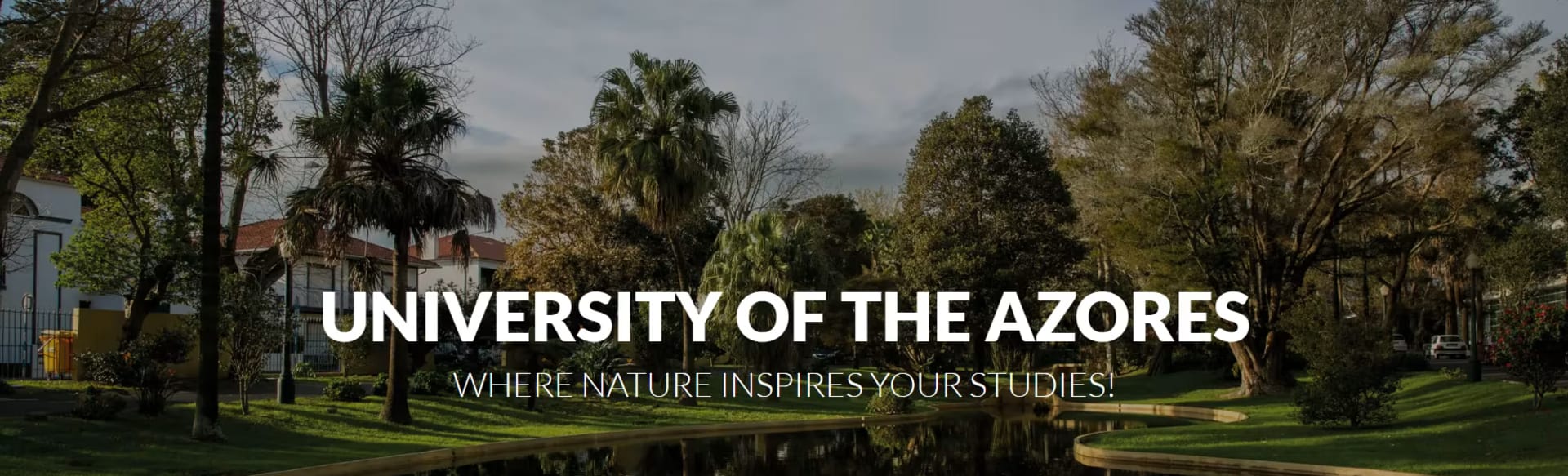
- Campuses integrated into a natural environment