- PhD
- On-Campus
Ph.D. in Agricultural & Biosystems Engineering
- duration
- 3 up to 5 years
- languages
- English
- pace
- Full time
- Application Deadline
- Earliest start date
international applications are due May 1 for fall and October 1 for spring. Domestic applications must be received at least one month prior to the start of the semester
At a glance
About: The Ph.D. in Agricultural & Biosystems Engineering at North Dakota State University (NDSU) focuses on engineering solutions for agricultural production, biofuels and food processing, and environmental resources management. Research areas include irrigation, hydrology, soil and water management, livestock waste, air quality, process engineering, machine systems, precision agriculture, machine vision, and post-harvest storage. Programmes are individualized and interdisciplinary; they're paired with professional development and Three Minute Thesis at a student-focused land-grant research university in Fargo, ND.
Career Outcomes: Graduates can enter academia, industry R&D, government, extension, agribusiness, biofuels, precision agriculture, machinery design, post-harvest logistics; roles include research engineer, and faculty.
The Department of Agricultural and Biosystems Engineering offers graduate study leading to M.S. and Ph.D. degrees. The program emphasizes solving engineering problems for agricultural production, food and biofuels processing, and environmental resources management. Advanced work may involve specialized training in the following areas:
- Irrigation and drainage engineering
- Agricultural hydrology
- Soil and water resources management
- Livestock waste management
- Air quality, process engineering for food and biofuels, and other bioproducts
- Agricultural machine systems
- Precision agriculture
- Machine vision and intelligent sensors for biological systems
- Post-harvest handling and storage of biomass feedstocks and other biological materials
Student research and academic programs are tailored to individual student needs and interests. Interdisciplinary approaches to agricultural and biosystems engineering programs are fostered.
The Department of Agricultural and Biosystems Engineering graduate program is open to all qualified graduates of universities and colleges of recognized standing.
Admission Requirements
To be admitted with full standing to the program, the applicant must meet the Graduate School's admission requirements and have a baccalaureate degree in engineering or have taken the equivalent of the basic undergraduate engineering courses.
GRE scores are not required for admission.
Prerequisite Courses
Any student receiving an M.S. or Ph.D. degree from the NDSU ABEN department must have taken the following fundamental courses prior to attaining the graduate degree. If the courses (or their equivalent) were not taken prior to matriculating at NDSU, they should be taken in addition to other coursework required for the graduate degree.
- Mathematics through Differential Equations (NDSU: MATH 266 Introduction to Differential Equations)
- Statics (NDSU: ME 221 Engineering Mechanics I) and Dynamics (NDSU: ME 222 Engineering Mechanics II); these two may be substituted by a calculus-based Physics I class
- Thermodynamics (NDSU: ME 350 Thermodynamics and Heat Transfer); may be substituted with ABEN 644 Transport Processes, which may also count toward graduate degree
- Fluid Mechanics (NDSU: CE 309 Fluid Mechanics or ME 352 Fluid Dynamics)
- Physics II/Electricity and Magnetism (NDSU: PHYS 252 University Physics II)
English Proficiency Requirements
TOEFL ibt 79; IELTS 6.5; Duolingo 105
See Frequently Asked Questions Here
Degree Requirements
Ph.D. candidates are encouraged to indicate their research interests when applying for admission and to select an adviser before entering the program. Typically, 3-4 years are required to complete the Ph.D. program after the completion of an M.S. degree.
The degree requirements are in accordance with the NDSU Graduate School requirements. The student's academic adviser will usually be selected during the acceptance process. Prior to the end of the first academic year, the student and academic adviser will arrange for the appointment of a Graduate Advisory Committee.
The student and major adviser will prepare a Plan of Study by the end of the first year in residence. The student's Graduate Advisory Committee, the ABEN Department Chair, and the Dean of the Graduate School shall approve the Plan of Study. The Plan of Study (PoS) must be filed in the Graduate School of NDSU. An overall GPA of 3.0 or above must be maintained.
Degree requirements details here
Financial Assistance
Research assistantships are available and dependent on the grant funding of faculty research programs. Applicants are considered on the basis of scholarship and potential to undertake advanced study and research. Students must be accepted into Graduate School before they are eligible for an assistantship.
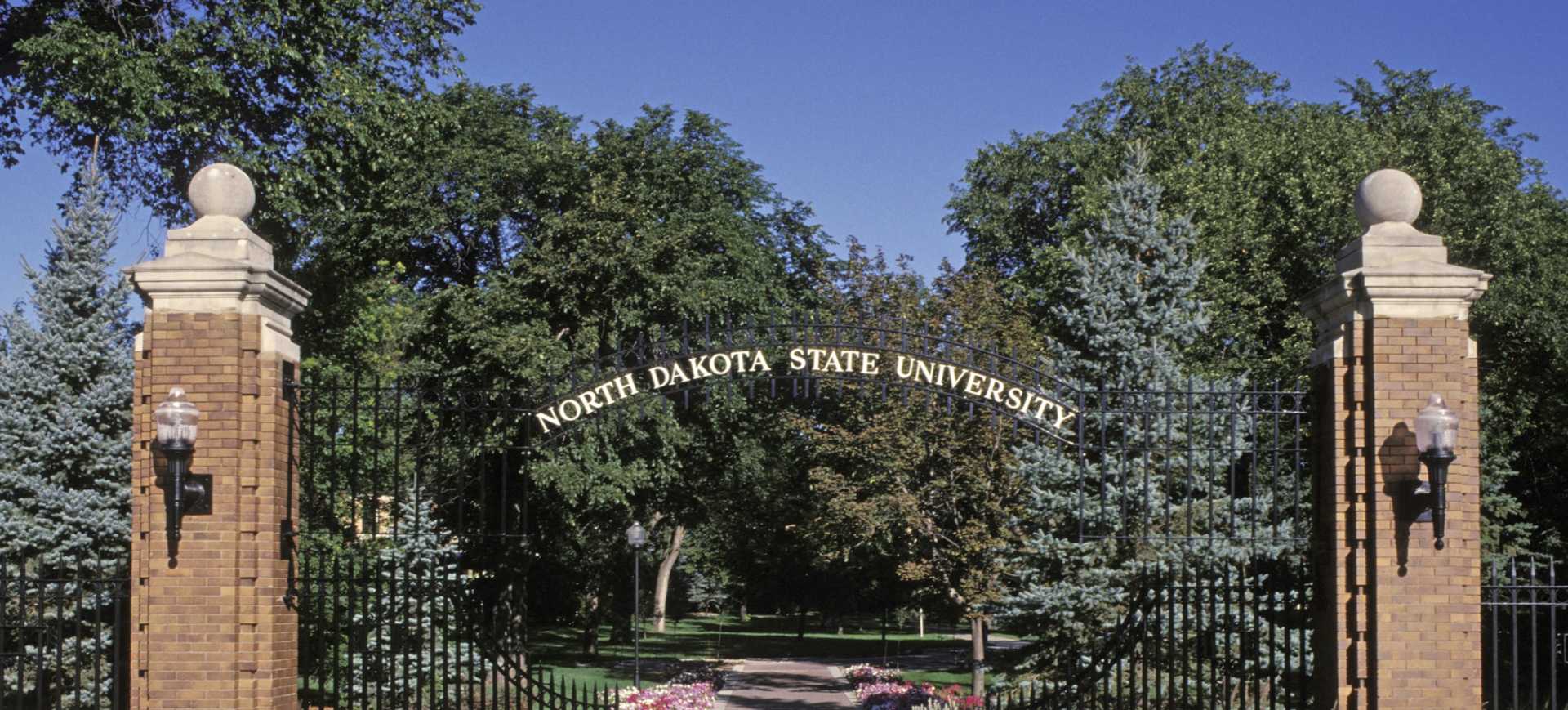
North Dakota State University is distinctive as a student-focused, land-grant, research university.
NDSU is ranked 94 among public research universities based on NDSU’s research expenditures reported to the National Science Foundation. In addition, NDSU is listed in the National Science Foundation’s top 100 in several areas, including agricultural sciences; business management and business; communications; computer sciences; natural resources and conservation science; political science and government; social sciences; sociology, demography, and population studies; and visual and performing arts.
The main campus is in Fargo, North Dakota, with Extension Service and Research Experiment Station locations across the state.
Mission, Vision, Core Values
Mission
With energy and momentum, North Dakota State University addresses the needs and aspirations of people in a changing world by building on our land-grant foundation.
Vision
We envision a vibrant university that will be globally identified as a contemporary metropolitan land-grant institution.
Core Values
NDSU is guided by the following key values and principles:
Land-Grant
We reflect and serve geographically and culturally diverse populations. We share institutional success across the university. We anticipate and welcome growth and service that will occur in ways yet to be conceived. We embrace our unique complexities as a land-grant university on the Northern Great Plains. We remain committed to serving people globally.
People
We derive strength and vitality from each other and from the diverse communities we serve. We envision an academic and social environment that is conducive to intellectual and personal development by promoting the safety and welfare of all members of the university community. We promote excellence through individuals participating in decisions and value cooperation for the common good.
Teaching and Learning
We provide a superior teaching and learning environment within and outside the traditional classroom. We promote and value liberal, graduate, and professional education in a collegial environment where divergent ideas can be shared. We foster an environment that promotes life-long learning with individually defined goals.
Ethics
We maintain our integrity through principled action and ethical decision-making.
Culture
We will be the land-grant university that we want to be by welcoming and respecting differences in people and ideas. We support the goals of the North Dakota University System and value collaboration with colleges and universities around the world. We foster accessibility to our programs and services.
Accountability
We have a special relationship with and are accountable to, the people of North Dakota. We actively strive to contribute to our region's economic prosperity and to improve the quality of life.

North Dakota State University - Graduate School
1340 Administration Ave., Fargo, 58102, Fargo