

Architectural Association - School of Architecture
Emergent Technologies and Design (EmTech) MSc/MArch
London, United Kingdom
MSc
DURATION
16 months
LANGUAGES
English
PACE
Full time, Part time
APPLICATION DEADLINE
EARLIEST START DATE
TUITION FEES
GBP 36,000 *

STUDY FORMAT
On-Campus
* for MSc | £43,850 for MArch (16-month)
Key Summary
About: EmTech MSc/MArch at the Architectural Association explores synergies of architecture and ecology across computational design and advanced fabrication. The programme combines studio-led, research-driven projects and a dissertation phase, emphasizing iterative hypothesis, experimentation, fabrication and evaluation. Students work in teams and as individuals, develop technical and theoretical foundations, document findings in papers, and engage with faculty, alumni and industry collaborators. Keywords: computational design, advanced fabrication, design research, ecology, urban design, systems.
Career Outcomes: Graduates can pursue roles as computational designers, architects, fabrication specialists, associates in academic or industry labs, or consultants in urban ecological design, digital fabrication, practice and startups.
EmTech investigates new synergies of architecture and ecology at the intersection of computational design and advanced fabrication, with a focus on the potential these offer for new architectural, urban and ecological design solutions within emerging biomes. The programme stimulates critical thinking through research-driven design projects developed in a rigorous and creative studio environment. Our projects evolve iteratively through hypothesis, experimentation, fabrication and evaluation; students reflect upon this work in verbal presentations and group discussions, and document their findings in analytical papers.
The programme has two distinct phases: the Studio and the Dissertation. Both phases are supported by the research of the programme team and by the expertise of EmTech alumni, alongside an extensive network of research colleagues in practice and industry. As well as building strong technical and theoretical foundations, students develop valuable teamwork skills throughout the programme. During the Studio phase, they work in teams while contributing individually at key stages of each project. In the Dissertation phase, students have the opportunity to collaborate with peers who share similar research interests, further enhancing both their academic and professional experience.
Design research is central to the programme’s agenda, and student work develops from the understanding that nature and artifice are connected, that the cultural production of artefacts and systems exist as part of other active systems, and that these systems are subject to change. The programme acknowledges that the causality of change is complex and multi-scalar, and that its dynamics are disrupted and accelerated by human activity. Our work critically examines the consequences of such changes within society and the natural world, and we develop architectural interventions that align with these shifting material, environmental and socio-technical flows to support resilient and habitable spatial futures.
Student Work Videos
Explore a diverse selection of student projects from the MSc and MArch programmes through our end-of-year showcase videos from the past two years.
AAPR 2025: https://youtu.be/w0pokHdYfHk?si=LKC_vwK20mgUNxIo
AAPR 2024: https://youtu.be/C0XAvoUzG_w?si=BE1UFcvXvd2_S5f9
Phase 1 Design Projects
Design 1: Digital and Material Fabrication
This project highlights the ways in which physical and digital computational techniques can be used to adapt different material systems to specific climatic contexts. Students use digital models to respond to various environmental parameters, and create physical models that integrate material behaviour and robotic fabrication processes. The purpose of the project is to design and develop computational workflow techniques, and to analyse and fabricate material systems within EmTech’s ‘Design and Build’ research agenda.
Design 2: Ecological Urban Design
In this project, students create experimental designs and system logics for settlements situated in extreme climates. They develop design strategies that support both inhabitation and production within biomes undergoing rapid ecological transformation. These strategies integrate infrastructural systems and networks with spatial configurations of dense or distributed inhabitable units, alongside productive landscapes characterised by their own operational networks.
Elective
Climate and Ecological Systems in Design Science
The scientific method is an evolving set of procedures based on systematic observations and measurements, forming hypotheses from those observations, testing hypotheses through experimentation, and modifying and further testing them in response. The aim of the process is to arrive at a point where there is no difference between the hypothesis and the observed results of the experiment. The course introduces scientific inquiry into students’ design and design research practices.
Phase 2
The Dissertation
The Dissertation Research Studio extends students’ research skills with a view to applying these in advanced production processes within architecture, urbanism and ecological engineering. Students learn how to analyse complex issues and to engage in independent research, integrating insights gained from case studies with those from digital and material experiments
We operate across a spectrum of contexts, anchored by two core areas of design research: dynamic material systems with advanced fabrication, focusing on technologies applied at the scale of medium-to-large buildings and landscapes; and ecological urban design in emergent biomes, which explores how integrated technologies can operate within landscapes such as shorelines, river valleys, deltas, mountains and deserts.
Students explore theoretical discourses, science and case studies that relate to their chosen topic and set out the methods through which they will develop their Design Proposal, which unfolds through iterative design cycles as they apply the knowledge and skills gained during earlier phases of the programme.
Design and Build
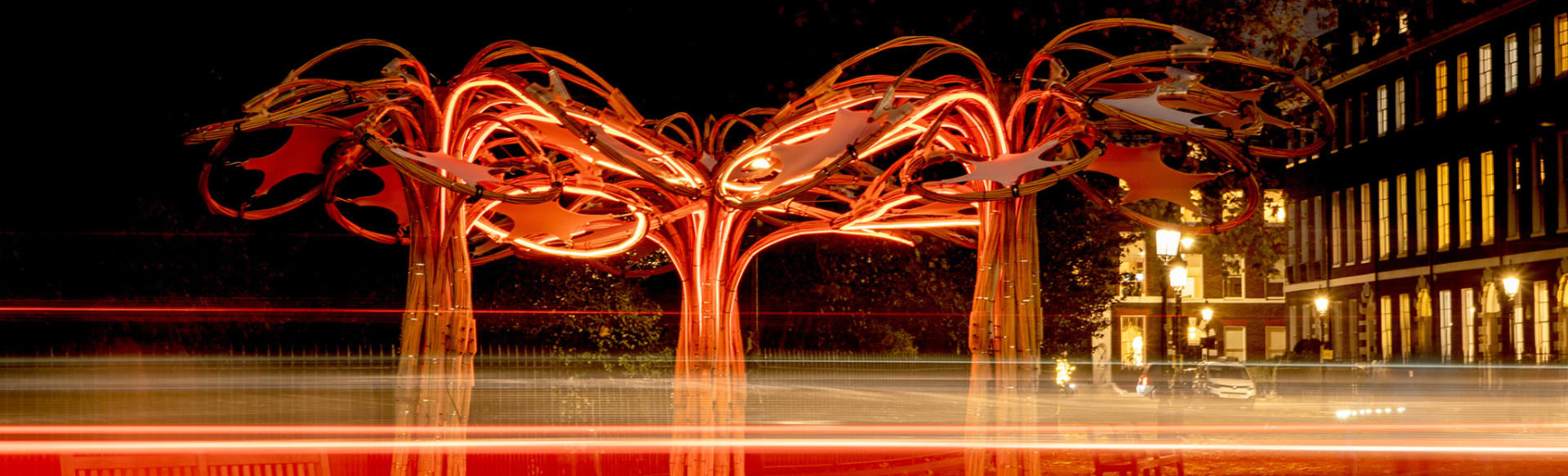
Design and Build is a collaborative student project and makes an essential contribution to the culture of EmTech. The project runs throughout the year alongside the Studio and the Dissertation, and provides opportunities to design and deliver a built project within real-world material, structural, fabrication and assembly constraints. This enhances students’ design, computational and analytical skills, many of which are applicable within professional practice. Our Design and Build projects have been published internationally in the architectural press since 2001 and have received industry awards.
The AA offers bursaries to new students of the Postgraduate and PhD Programmes who demonstrate exceptional promise and financial need. All applicants are eligible regardless of nationality or background. Find out more about academic fees, the bursary application process and information regarding other sources of financial assistance on the Financial Assistance page.
Since its establishment in 1847, the Architectural Association (AA) has revolutionised architectural education and nurtured an international community of prize-winning thinkers, architects and innovators – among them, recipients of 15 Stirling Prizes, 4 Pritzker Prizes and 22 RIBA Gold Medals.
The AA is a school like no other. It provides its students with a dizzying breadth of choice and opportunity, lending the school both energy and extraordinary resilience.We are a community that extends beyond the confines of our campuses in London and Dorset to compose an international network of intrepid students, alumni and professionals at the forefront of industries from architecture to the sciences and arts.
The Studio
The Studio comprises workshops, seminars, electives and design projects led by EmTech staff and associated researchers. It encourages comprehensive engagement with design science and introduces students to a community of design researchers in practices worldwide. The Studio enables students to formulate a detailed proposal for an original architectural inquiry which they will later pursue in the Dissertation.
Phase 1 Workshops and Seminars
Design and Technology
This seminar enables students to develop proposals using advanced computational design, analysis and fabrication strategies. Sessions demonstrate how analytical tools can be used as methods for generative design and students explore a variety of computational workflows, concentrating on experimentation, analysis, evaluation and decision-making processes. A range of computational form-finding and analysis methods are introduced alongside the basics of C# programming and advanced digital fabrication techniques.
Critical Discourses
EmTech’s design method draws upon knowledge from architecture, social and natural sciences, computation and evolutionary theories. Each of these disciplines contains its own historical trajectories and canons, both written and built, which occasionally intersect, overlap and coincide. This seminar provides a shared space for discussion through which students can engage with historical narratives, empowering them to situate their work within existing fields of knowledge.
Natural Systems and Biomimetics
The course develops students’ understanding of how biology can be used as a model for material, mechanical, spatial and computational systems. It begins with an introduction to the ways in which organisms have evolved through form, materials and structures in response to different contexts, before examining research projects that harness principles of engineering and logical and organisational design which have been abstracted from nature. Students will develop a study of a natural system, exploring its interrelations and conducting an abstraction of its design principles.
Emergence and Evolutionary Computation
Evolutionary algorithms have been used extensively in recent years to mimic the principles of evolutionary science, solving real-world problems through search and optimisation procedures. These algorithms have provided an efficient problem-solving technique within a range of fields – from economics to politics and from music to architecture – to find solutions for problems whose objectives conflict with one another. This seminar introduces students to the key principles of multi-objective optimisation and builds an understanding of how these are applied in design practices. This enables students to integrate generative design workflows and deep learning methods into their own work.