Graduate School Application Trends - Insights From Boston University
Perfect your graduate school application with these tips from an industry expert.

✨ 5-second summary
- It's important to come across as authentic in your application - show your individuality.
- Universities generally consider three criteria: academic performance, student's fit for the program and community engagement potential.
- Research the institution properly and dedicate enough time to craft a compelling application.
Are you wondering how to stand out in college applications? If you're one of many students that are trying to figure out how to get into college, this article is for you!
We interviewed Mr Mark Khan, the Director of Marketing and Enrollment at Boston University Graduate School of Arts and Sciences, and asked him about the current graduate school application trends, and what advice he can offer to prospective students.
Here all of the helpful application tips we talked about in the interview.
Feeling inspired for graduate study?
Browse thousands of graduate programs worldwide!
Discover programs →What universities expect from students
Mr Khan describes the reciprocal university-student relationship during recruitment like this:
- Universities actively engage with students to encourage them to submit applications.
- Students then make efforts to persuade the universities to accept their applications.
- Once accepted, universities continue their engagement efforts to retain the students in their programs.
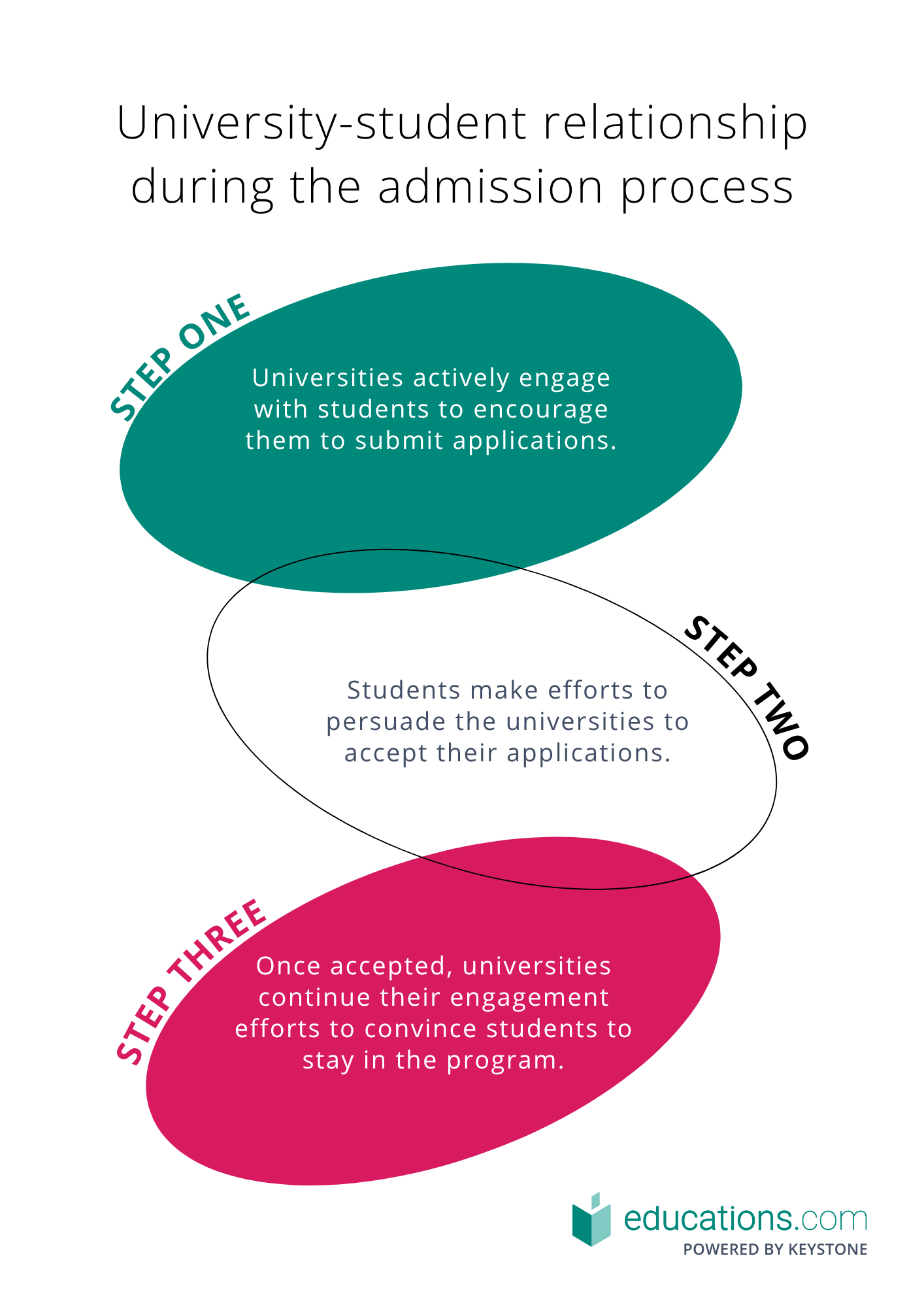
The university-student relationship during the recruitment phase can be seen as a continuous cycle of mutual persuasion and engagement. Both sides actively participate in this process, with universities trying to attract potential students and students working hard to secure their place.
Competition for limited program spots means students have to put more effort into standing out
As a student, you're no longer just competing with a neighbor down the street. You're competing with students from all over the world.
What's more, as students have become savvier, they are aware of the answers schools are looking for to secure acceptance letters, and they’re applying to significantly more schools (3-5 before, and 7-10 on average today) to increase their chances of being accepted.
This means that as a student, it's essential to differentiate yourself in some way.
The next section will focus on what universities look for in candidates and what red flags can cause your application to be disregarded.
🎓 As a student:
Remember that universities, especially graduate schools, expect their prospective students to actively engage and put in the effort to earn their spot.
Many universities, including Boston University, have dedicated program admission boards. This means that your application will be seen by many different faculty members. It's important to use this opportunity to show why you're a good fit for the program and what you’d contribute to the university if admitted.

What makes student applications exceptional
Student applications at Boston University Graduate School of Arts and Sciences are reviewed by the school’s faculty board. Mr Khan outlined the most common characteristics of applicants that are considered a good fit for the program they’re applying for.
1. Academic preparation
The student’s academic record is a good indicator of whether or not they would succeed at their programs. Boston University Graduate School expects their students to be strong academically, and to be high achievers in general.
2. Student’s alignment with the program
If the student has done their research on the program, as well as the faculty related to the subject they’re interested in (or whose laboratory they’d like to study in), then that candidate is probably a very good fit.
On the other hand, if a student is aspiring to do something that the program they're applying for doesn't offer, that’s a problem.
3. Potential for community contribution (culture fit)
This factor isn’t a number on a resume.
It’s communicated through the student’s essay, how their evaluators talk about them, their passion during the application/interview process, the research they’ve done, their extracurriculars, the papers they’ve chosen to be part of, and other similar factors.
All of these factors, combined, paint a picture of what a student will bring to the table beyond the knowledge that can be gained in a classroom.
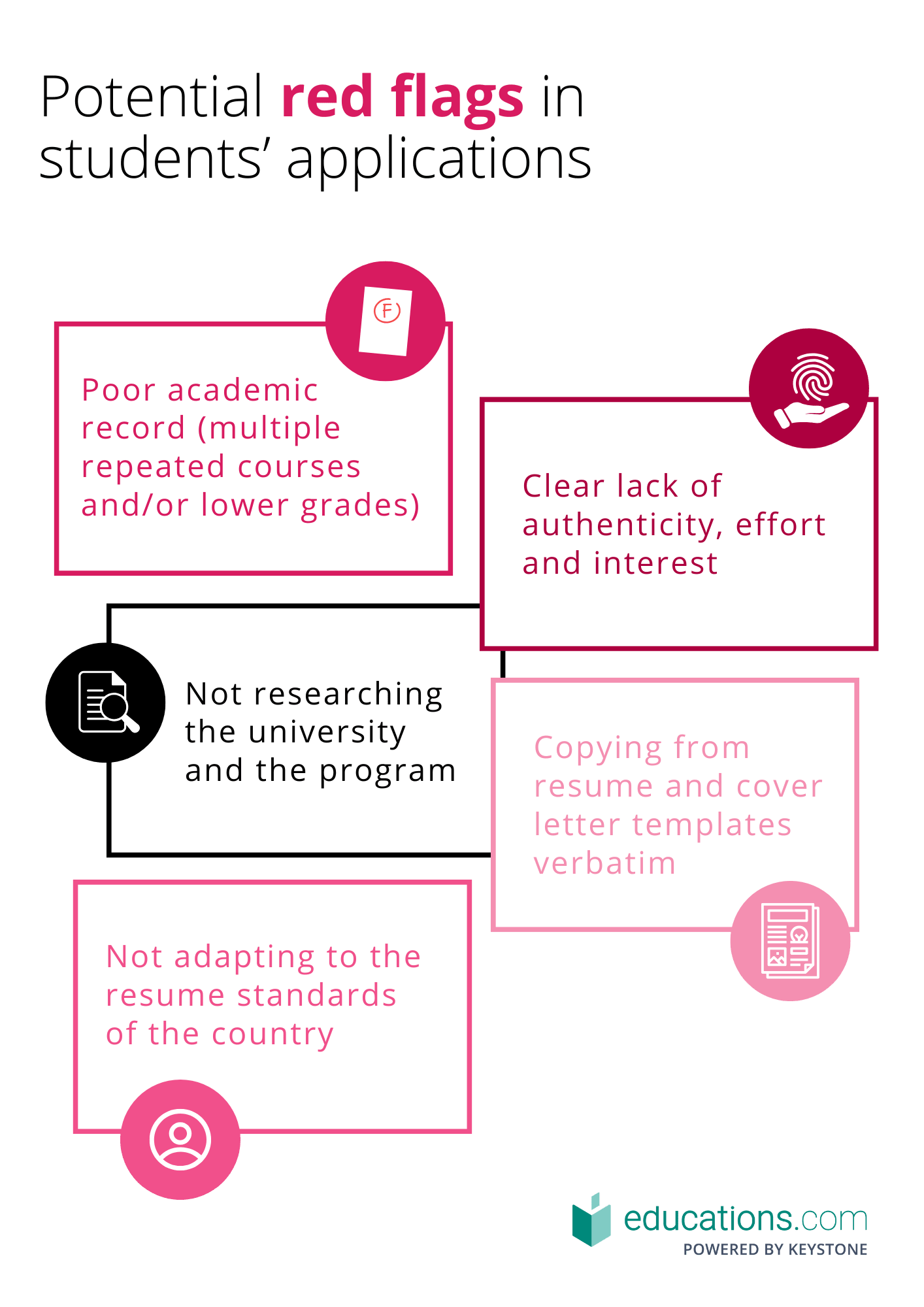
Potential red flags in students' applications
1. Poor academic record (multiple repeated courses and/or lower grades)
This may be concerning to universities because you’re given less time to tackle difficult material in graduate school, and there are rarely opportunities for a student to retake a class and still have a successful outcome in the end.
Similarly, universities want ambitious students who aren’t only satisfied with passing the course. They want their students to aim higher and achieve higher scores.
2. Clear lack of authenticity, effort, and interest
Universities want to know more about you. They don’t want you to copy and paste information from their website without authenticity. Don’t include obvious facts about the university, like the university’s founding date, without any context in your cover letter.
Focus on explaining why you’re the right fit for the university, and why the university is the right fit for what you’re trying to accomplish with your studies.
3. Lack of research
It’s a red flag if the applicant hasn’t done their research on the university’s program catalog.
To illustrate this point, here's an example: if you want to learn more about neural networks, but the program curriculum only briefly touches on AI, the school's admission board will recognize your lack of research into the program.
It's important to take time to research what the program offers (and what's not included), and then clearly explain how it fits into your academic and career goals.
4. Using resume and cover letter templates as a crutch
It's okay to use templates for your application documents, but it’s important to adapt them to your personal experiences and the university you’re applying to.
If you’re simply copying a template word-for-word, that’s a red flag for university admission boards.
5. Not researching the resume standards of the country you want to study in
While you might not get outright rejected for not adapting your CV/resume to local standards, it may give the impression of not caring/less effort into it.
For example, it's a big no-no to add one's photo, age, home address, and marital status to a resume in the US. But this is a custom in other countries. Research this etiquette in advance to boost your chances of a successful application.
PRO TIP: Reach out to the career center of the university that you want to apply for and ask for their resume/CV template. That will give you the best insight on what the faculty expects you to include, and how it should look.
🎓 As a student:
To maximize your chances of getting admitted to the university:
Two common student pitfalls
Pitfall 1: Trying to adapt to the university's "perfect image"
One of the hardest things for graduate international students is to get used to the fact that US universities care about their individuality. From Mr Khan’s experience, they oftentimes have an idea that there’s this ideal student profile they need to adhere to, and that they should adapt themselves to fit that mold.
Instead, most universities want to see your quirks, personality, and unique thoughts. It can speak volumes on the authenticity and the validity of your application, as opposed to trying to fit into the profile of what you think the university wants you to be like.
Be yourself, even if you think it’ll hurt you.
On another note, if you’re scared to speak up in class because you’re worried about your language skills, remember that you’ll only get better by practicing! Universities are populated by numerous international students each year, and all of them started from the exact same place as you.
Pitfall 2: Misusing ChatGPT in university applications
According to Mr. Khan, it’s okay to use ChatGPT like any other tool. But just like the online resume/cover letter templates, it shouldn’t be abused or used as a crutch. You have to do your due diligence: fact-check the information listed in the generated text, adapt it, rewrite it, and make it your own.
It’s very easy to tell when a text was written by ChatGPT, so it’s important to put in lots of effort to make the results authentic and unique to your personal experience.
Think of it as a dictionary - you can copy-paste all the words listed in the dictionary, but that won’t make for a solid essay. You have to add your own text and more context to turn those words into a coherent message.
🎓 As a student:
When approaching your application, remember that universities, and especially universities in the US, care about your individuality. They want to see your personality and view of the world.
If you're using ChatGPT to support your applications, make sure not to use it as a crutch - it's important to put in effort to make the text truly yours.

Demand for shorter programs is growing
It seems that students are also increasingly drawn to shorter educational programs, as these allow them to secure the necessary qualifications for specific jobs more quickly.
However, while many students are looking to fast-track their careers by opting for shorter programs, it's noteworthy that traditional university degrees still maintain their prestige and are regarded as more valuable than online certificates (a notable exception to this is if the student already completed a degree and is now trying to specialize in a specific area with a certificate course - in this case the student already has a solid basis to stand on).
In general, certificates are great for:
- Building on a solid basis of knowledge
- Pivoting your career path
On the other hand, they're not so great if:
- You're learning about a new field completely from scratch
- They don't have lots of credibility (not backed by a university or a reputable institution)
🎓 As a student:
Make sure to carefully weigh the benefits and limitations of shorter programs. On one hand, they can be an excellent way of acquiring knowledge and skills specialized in a particular area, but you will be missing out on the more comprehensive curriculum that longer programs are made of.
Modern students are consumer-savvy
When asked about the most frequently asked questions that students ask Boston University recruiters, Mr Khan gave the following examples:
- What are my career outcomes?
- Will I be able to afford my studies?
- Can I get a job with this degree?
Students across the board have become more consumer-savvy. They want to know exactly what they’re getting for their money.
With the rising costs of graduate programs, you want to know that it will be worth it, that the product is a smart investment.
Particularly in non-STEM, non-tech fields, students want to know that it’s not just a waste of money, energy and time.
🎓 As a student:
Don't feel discouraged to ask about the return on investment of your studies! Universities are happy to help you find the right program that'll allow you to succeed and pursue your academic and career goals.
Other trends in graduate student recruitment
Most popular Boston University graduate programs
Generally, the most popular Boston University graduate programs at the BU Graduate School of Arts and Sciences are in IT, data science and artificial intelligence. For example:
Interestingly, Mr Khan noted that there was a dip in interest in economics programs recently.
His observation seems to coincide with a global trend. Here are the worldwide searches for "economics programs" (blue), "data science programs" (red) and "computer science programs" (yellow) from 2018 to 2023.
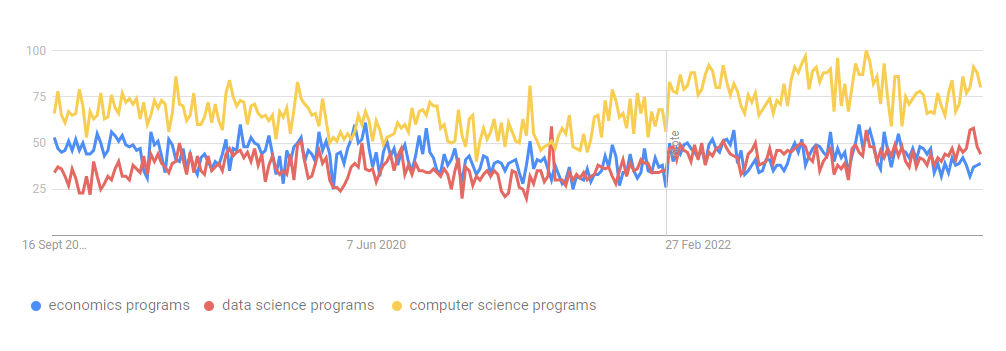
Source: Google Trends, 2023
The sudden surge in interest in data science could be explained by the explosive growth of AI in the last year, spearheaded by the public release of ChatGPT.
Why are graduate studies growing in popularity?
It seems that, in order to stand out in the modern job market, it may no longer be sufficient to hold just an undergraduate degree:
Undergraduate is the new Bachelor’s in a way, so you almost need that expert, specialized knowledge to differentiate yourself from the rest.
People might need to consider advancing their expertise to a higher level, possibly by seeking further education or training in specific areas, to distinguish themselves among the increasing number of graduates.
About Mark I. Khan

We had the pleasure of chatting about various student trends in university admissions with Mark I Khan, the Director of Marketing and Enrolment at Boston University Graduate School of Arts and Sciences.
In his own words, he's dedicated his career to "promoting the benefits of globalization, intercultural discourse, social impact and diversity of thought [in order to] positively transform individuals, communities, and the world in which we live".
About Boston University Graduate School of Arts and Sciences
Founded in 1874 as the School of All Sciences, Graduate School of Arts & Sciences is Boston University’s largest academic division, the heart of a world-class research university. The faculty of the Graduate School of Arts & Sciences is among the world’s most respected professors, researchers, and professionals in their disciplines.
Interested in learning more about Boston University Graduate School of Arts and Sciences and its programs?
Feeling inspired for graduate study?
Browse thousands of graduate programs worldwide!
Discover programs →
Sara EvansAuthor
🌟 Expertise: Design, Business
Sara is the Content Team Manager at educations.com, where she oversees editorial content for students worldwide. She holds a Bachelor's degree in Interactive Media Design and a Master's degree in Digital Business with a specialization in higher education marketing. Her own study abroad experience in the Netherlands gives her direct, personal insight into the opportunities and challenges students face when pursuing education internationally.